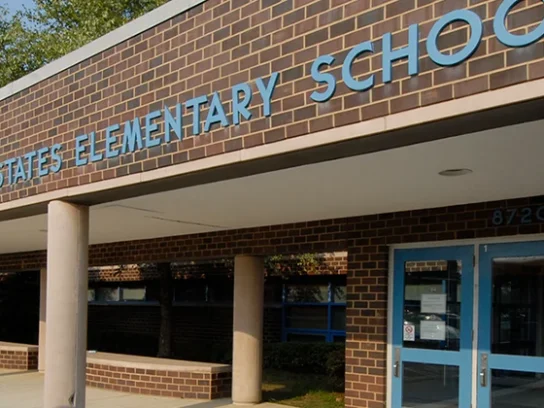
Sixteen students and nine staff members at New Hampshire Estates Elementary School say they fell ill due to classroom conditions last month, as Montgomery County Public Schools continues to locate and repair possible air quality health issues.
On Feb. 26, the students and staff reported difficulty breathing, headaches, nausea, shortness of breath and coughing.
The on-site health technician evaluated the students involved, and the Division of Facilities Management reviewed live data from indoor air quality sensors in classroom where the alleged sickening occurred, according to a letter dated March 3 from Andrea Swiatocha, MCPS deputy chief of facilities management.
The sensors take measurements of temperature, humidity, carbon dioxide and airborne particulate matter throughout the day. On that day that several students and staff had medical issues, according to the letter. The sensor readings did not indicate unsafe conditions,
The following day, the Division of Facilities Management environmental safety and health professionals inspected the room and spoke with teachers. The conditions were found to be acceptable. There was no evidence of moisture issues, mold or hazardous chemical pollutants, according to Swiatocha.
However, while within an acceptable range, this classroom showed higher readings than nearby classrooms, according to the letter from Swiatocha, which was forwarded to MCM by MCPS upon request.
The school’s HVAC system that serviced that classroom was tested, and no problems were found, according to MCPS.
However, when students returned to school on Monday, March 2, some children complained of a “metallic taste” in their mouths after breathing air in that same classroom.
PTA President Nancy McInerney sent a letter to Superintendent Thomas Taylor. “We are requesting immediate action, including a transparent report of findings and prompt remediation of any identified hazards,” she wrote.
The fire department was called and crews determined that the CO and oxygen levels in two classrooms were normal. First responders “determined that possible residual mold could account for the metallic taste,” stated in the letter.
Despite not being able to determine what was wrong, the school still replaced the air filters for the portable air cleaner and said they have plans to replace stained cork boards. Crews will install upgraded sensors in the affected classroom and other nearby classrooms, as well.
The new sensors will measure additional potential air contaminants, including volatile organic compounds, carbon monoxide and ozone.
On March 4, Swiatocha sent out a follow-up letter detailing steps MCPS is taking to resolve the issue, some of which previously have been announced.
Repairs to moisture and air quality at the school were completed in the summer of 2025, according to Swiatocha’s letter. Design improvement plans to control humidity and improve ventilation have been finalized.
In Superintendent Taylor’s proposed Fiscal Year 2027 to 2032 capital improvements budget, $2.2 million is included for this work.
“Please know that our MCPS facilities team and contractors are working diligently and in close coordination to complete all work as quickly and efficiently as possible,” Swiatocha wrote.
But PTA members are not satisfied. In the president’s letter, she complained that MCPS did not address the problem until one day after students and staff became ill.
According to the PTA letter, the Title 1 school that was constructed 72 years ago is in bad shape. Its “structure is deteriorating, ventilation does not extend to all classrooms, and water is seeping into the basement and foundation.”
County Councilmember Will Jawando addressed the issue on Facebook, stating he was “deeply concerned about the ongoing air quality emergency.”