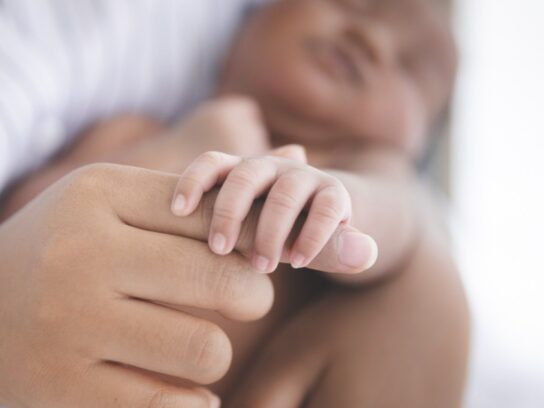
Councilmember Laurie-Anne Sayles held a committee hearing Thursday to learn why Black mothers and infants are more likely to die during pregnancy and childbirth than Montgomery County women of other races “despite being one of the healthiest counties in the nation.”
Services offered in the county are not addressing this disparity, Sayles said. “Black infants in our county are twice as likely to die in infancy compared with a white infant,” Sayles said. She also noted that “Black woman face a 42% chance of [receiving] a cesarian section as compared to 33% for white women.”
“Every day we delay action, we risk losing another mother and child,” she said.
She asked the county Department of Health and Human Services to produce a written action plan with measurable goals within 60 days on how best to address the issue of racial disparities in maternal and infant health outcomes in Montgomery County.
She also asked the DHHS to look into establishing a birthing center, which the county had, but closed 13 years ago due to financial constraints.
In Montgomery County, death rates are on the rise for all pregnant women, but they are raising more for Black women, according to Chitra Kalyandurg, legislative analyst with the Office of Legislative Oversight. Her office displayed charts breaking down the problems.
Black women in Montgomery County experience the highest rates of severe maternal morbidity, cesarean births, preterm births, low birthweight babies, and fetal and infant deaths.
The fetal mortality rate between 2017 and 2021 was 7.9% for Black infants and 5.4% for all infants born in the county. The infant mortality rate during the same years was 8.6% for Black children and 4.9% for all babies in the county.
Without even seeing all the data that was presented Thursday, “I knew that Black mothers and babies are not okay,” Sayles said.
The county offers three home-based case management and education programs serving pregnant people with a focus on low-income mothers and their babies. Those programs are Montgomery Perinatal Program, Babies Born Healthy and Start More Infants Living Equally.
The largest program is the perinatal one, which serves 1,500 clients. Most of the clients are Latinx mothers, because they were targeted when the program was first established, Now, people are added to the programs on a first come, first serve basis.
There are waiting lists for the programs. More can’t be handled “with the current resources we have,” said Dr. Nina Ashford, chief of public health services for the county.
Councilmembers Kristin Mink asked if more money was provided, could more women be helped right away. Ashford said that more money would help a lot to educate and help more women.
“If we need money then we need to say we need more money,” Sayles said, noting that this is budget season.
“It’s on us, at the local level, to make better decisions” about how money is spent, especially with the federal cuts to many programs. “If we don’t take action now, no one else will.”


Comments are closed.