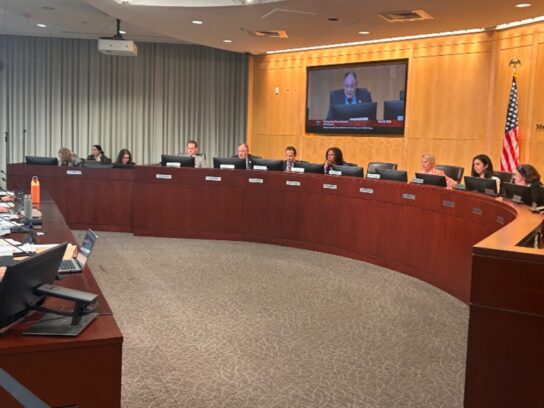
This week, Montgomery County Executive Marc Elrich defended his recommendation to close the county’s incinerator and trash processor after councilmembers reviewed various choices on how to proceed when the county’s contract for its incinerator in Dickerson expires in five years. Elrich’s recommendation to close the incinerator was one of four options reviewed in a Tuesday council session.
The county’s options, provided by Department of Environmental Protection:
- Continue operating the incinerator and upgrade it
- Close the incinerator and haul trash via truck to a landfill outside of the county
- Close the incinerator, implement Advanced Waste Processing (AWP), haul the remaining trash via truck to a landfill outside of county
- Continue operating the incinerator while developing AWP, then close the incinerator and switch to AWP and landfill the remaining trash
Much of the focus Tuesday was on the first and third options listed above. Option three, which was Elrich’s proposal in March during the budget season, is focused on reducing waste.
Currently, trash is sent from the Shady Grove Transfer Station via train to the incinerator, and then the ash is taken by train to a landfill in Virginia.
What is Advanced Waste Processing?
AWP involves a facility that receives trash and separates recyclables, like metal and plastic containers, organic materials, like food, and trash. The remaining trash would be trucked to a landfill. It would supplement the county’s existing recycling program, not replace it. The county’s environmental experts describe it as “a second chance” to capture materials before disposal.
The county currently has a request for proposals due Oct. 14 for AWP technologies, according to Department of Environmental Protection (DEP) Director Jennifer Macedonia. It is designed to let companies propose what they think the best technology and location for that system is in the county. According to a county document, a company would design, construct and operate the system. In exchange, the county would offer use of the Shady Grove Transfer Station to construct the system and would pay the company a per-ton fee to process waste.
Councilmembers consider ‘the least bad decision’
“It looks like we’re talking about how do we make the least bad decision,” Councilmember Kate Stewart said during council session Tuesday.
Councilmember Shebra Evans agreed. “My colleagues are right, there’s not going to be a good option that we will be deciding on,” said Evans. “I hate to say this: the least worst option.”
Evans said some of the options rely on AWP and noted the county doesn’t have the technology selected yet.
“What happens if the advanced waste process achieves less than the assumed 30% diversion rate or if it fails?” Evans asked. The county projects that AWP will divert 30% of the waste stream.
County Executive Marc Elrich responds
Elrich said there is a lot of misinformation out there. He said he has visited multiple facilities to see how AWP works.
Speaking Wednesday in a media briefing about the request for proposals that the county has out, Elrich said: “Everything that is in our ask are things that are actually existing and being operated in other places around the country.” He added, “Everything is something that other people have used and are using successfully.”
“There’s nothing there that’s just, ‘I wonder if it’ll work.’ Whatever we pick are things that’ll work,” Elrich said.
All options increase costs
DEP Chief of Zero Waste Programs Kayley Laleker said there will be cost increases over time regardless of the option picked because both systems require investments going forward. The incinerator would need upgrades if it is kept. If it’s closed, a new system needs investment. Closing the incinerator is slightly more expensive long-term than keeping it.
The county transportation department conducted a traffic impact study around the transfer station and found minimal impacts based on the level of additional truck traffic. The long-haul plan would require 80 loads per day, which means 40 tractor-trailers each making two trips from the station. But, this coming November, the county plans to limit acceptance of large loads of construction materials at the station, which will reduce truck traffic by 50-55 loads daily.
A study found that landfilling trash outside of the county would produce slightly lower greenhouse gas emissions than keeping the incinerator. Closing the incinerator would eliminate air pollution emissions like heavy metals, dioxin and furans.
Also, a new landfill will be selected no matter the decision. The landfill currently used for the county’s incinerator ash is in Henrico County, Virginia near a community with a high minority and low-income population. If the incinerator is kept operating under the first option listed above, the county would pick a new ash landfill, which requires a long-term contract and likely increased cost.
If the incinerator closes, the trash would go to out-of-county landfills that were “selected in part based on their environmental justice screening and how well they would avoid negative impacts to those communities,” according to Laleker.
What’s next
Council President Natali Fani-González said she aims to have a council decision by Thanksgiving. But Elrich says, “I think they should take as much time as they need. I think self-imposed deadlines when you have no clue about what kind of information you need, and what kind of questions you want to ask after you start learning more, is a bit pointless.”
The council will continue to meet on this topic. A majority of councilmembers must approve a plan.
The next work session is Sept. 29.