
Officials continue cleanup and monitoring nearly a month after a major sewer line collapse in Montgomery County released raw sewage into the Potomac River.
Meanwhile, DC Water now stresses regional drinking water remains safe.
On Jan. 19, a 72-inch section of the Potomac Interceptor sewer line, owned and operated by DC Water, collapsed near the Clara Barton Parkway. The breach sent an estimated 243 million gallons of untreated wastewater into the river, according to the Maryland Department of the Environment, which oversees sewer overflow compliance.
DC Water crews completed an emergency bypass system in late January that rerouted sewage away from the damaged pipe, limiting further overflow into the river. Bypass pumping continues while crews prepare the damaged section for more permanent repair. Officials estimate emergency repairs could take four to six more weeks, after which full pipeline restoration and rehabilitation are expected to take up to nine months.
The utility reports no additional overflows into the Potomac since early February, and the bypass improvements are intended to prevent future leakage during high-flow conditions.
Crews have successfully tested the bulkhead system & the enhanced bypass pumps at the Potomac Interceptor. Six of seven new high-capacity pumps are online, & the full bypass system should be operational by week’s end, allowing emergency repairs to start.🔗 https://t.co/4axoubDMlH pic.twitter.com/bVCckd3D3g
— DC Water (@dcwater) February 18, 2026
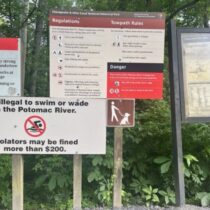
State and local environmental and health departments continue weekly bacterial monitoring in the Potomac and its channels. The DC Department of Energy and Environment notes that the river water affected by the spill contains elevated levels of bacteria, particularly E. coli, and recommends that people and pets avoid unnecessary contact with the river.
Officials also note that drinking water systems serving the Washington area are unaffected by the spill. That includes supplies treated and monitored by the Washington Aqueduct, a U.S. Army Corps of Engineers unit that draws raw water from the Potomac upstream of the spill site.
As a precaution, shellfish harvesting closures remain in effect from Charles County to the Route 301 Bridge in Maryland, and health advisories are active in Montgomery, Prince George’s and Charles counties.
The DOEE reports data showing reductions in bacteria levels since the bypass system was installed, but continued monitoring is required to assess environmental impacts and potential long-term effects on aquatic life. Wildlife surveys are planned for late February.
According to the Maryland Department of the Environment, responsibility for cleanup and remediation is shared among DC Water, the EPA and state agencies, including the Maryland Department of the Environment. DC Water leads containment, monitoring and recovery operations, while state departments enforce applicable water quality laws.
Officials emphasize that the spill originated from aging infrastructure outside direct state jurisdiction, and that collaboration among multiple agencies is central to the response.
Comments are closed.