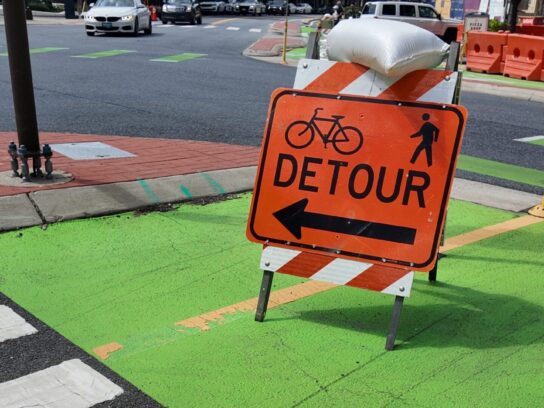
The shortest way across Montgomery County on a bike is rarely the safest one. Riders here learn to add miles, detour through neighborhoods and cut over to trails, all to avoid the stretches where a bike lane runs out and traffic picks up.
They’ve done the math on what that costs them. Montgomery County is adding bike lanes and trails in Bethesda, Silver Spring and Wheaton, with 20 more projects planned. The Montgomery County Department of Transportation says the work builds toward a safer, more connected network. Riders agree that’s the right direction. They also say the connections aren’t there yet.
The network problem
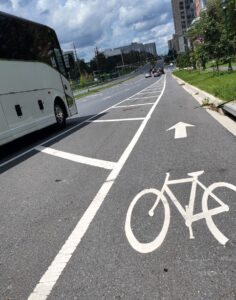
Cyclists have to share the lane closely with buses and cars on this stretch.
Peter Gray has lived in Montgomery County for 36 years and works as a staff organizer with the Washington Area Bicyclist Association (WABA). He’s spent a decade helping shape the county’s approach to bike infrastructure, including an equity-focused overlay on the county’s own bike master plan.
“All those are good projects, but they need to create networks,” Gray said. “If there is not a complete way to get from where you started to where you are, people are not going to do it. They will say this is dangerous; I can’t do that. We need to have networks.”
The county’s own project list shows what riders mean. Twenty-three projects are underway or in design, each a separate stretch on a separate road, from a quarter mile in Bethesda to just over a mile in Wheaton.
A segment is one of those stretches. A network is when they connect, so a rider can get from home to work or school without dropping back into regular traffic partway through the trip.
Commuters feel the gaps directly
Max Silverstone, a WABA member who commutes by bike five or six days a week from Rockville to Potomac, hit the same point without being asked about it directly.
“You might have a 5-mile commute, maybe 4 miles of it has safe bike lanes, 1 mile doesn’t,” Silverstone said. “Because of that 1 mile, you’re just going to leave your bike at home and drive.”
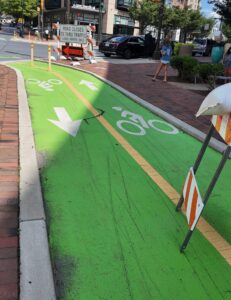
Bike lane on Woodmont Avenue in Bethesda, MD.
Silverstone’s commute runs into that gap directly. Rockville, an incorporated city, built its own bike infrastructure along Falls Road, rated bronze by the League of American Bicyclists. But once he crosses into county territory toward Potomac, the sidepath ends.
“My only options are riding on Falls Road, which is very unpleasant, or taking neighborhood streets, but I have to go two miles out of the way just to make one mile of progress,” Silverstone said.
He described a similar problem in downtown Bethesda, where Woodmont Avenue bike lanes switch from one side of the road to the other partway through, forcing riders to cross traffic twice to stay in a protected lane.
A pattern riders keep naming
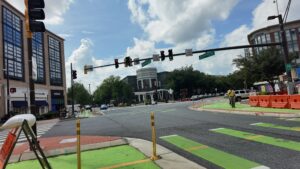
Cars, pedestrians and cyclists share the same crossing at Bethesda Avenue, where riders say the bike lane doesn’t clearly connect.
Elyce Jacobs, a retired rider who bikes for errands, exercise and recreation, described the same intersection as dangerous.
“By Woodmont and Bethesda Avenue, where you come off the Capital Crescent Trail, you have cars in different directions, you have walkers,” Jacobs said. “I’m always seeing people slam on their brakes.”
Jacobs said the pattern repeats across the trails she rides regularly, including a stretch along Little Falls that runs parallel to the Capital Crescent Trail for a while, then simply stops.
“They could say, ‘Oh, we have all these bike trails,’ but it’s stop and start without thinking about it,” Jacobs said. “I feel like they’re more symbolic.”
What bike shops know
Bruce Sawtelle, owner of Takoma Bicycle, hears the same complaint from a wide range of customers.
“Traffic, unobservant or distracted drivers who don’t know bike rules on roadways,” Sawtelle said. “Lack of safe places to ride is the primary concern.”
Customers ask him most often about East-West Highway, River Road and Bradley Boulevard.
Jacobs has ridden East-West Highway and confirmed there’s no bike trail there.
“That would be a good spot,” Jacobs said, if a lane there connected into the rest of the network rather than standing alone.
What the investment covers
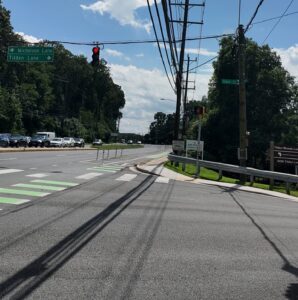
The protected bike lane on Old Georgetown Road begins near Nicholson Lane, but riders say one segment isn’t enough.
Montgomery Community Media reported on the county’s new bike infrastructure. Two miles of trail are under construction in Bethesda, Silver Spring and Wheaton. Twenty more projects are planned, adding nearly 18 miles.
None of the 23 projects under construction or in design touch East-West Highway, River Road or Bradley Boulevard. Bradley Boulevard has a separate project on the books. It traces back to a 2005 county bikeways plan. It wasn’t part of this round.
Gaps in the project list aren’t the only source of frustration. Some riders say the county also struggles to explain the projects it does build.
Doug Scott, who has ridden county roads since 1975, said officials rarely explain their reasoning to drivers. He points to Old Georgetown Road, where lanes installed in 2020 and 2022 sat mostly empty for weeks. That road is a state project, maintained by the Maryland Department of Transportation, not MCDOT.
“The lanes simply raised the level of anger county drivers express at us, and I do not blame them,” Scott wrote. “Empty bike lanes are really lousy PR for cyclists.”
Jacobs said she rarely sees other riders on Old Georgetown Road either. She pointed to upkeep as part of the reason: broken flex posts, peeling green lane markings, and debris that collects in the lane.
“It’s not maintained,” Jacobs said. She led a ride there once with a senior cycling group. “Everyone said, ‘We’ll never ride on that one.'”
What MCDOT says
MCDOT spokesperson Matt Johnson said the projects come from several sources, not one priority list. Sources include the county’s 2018 Bicycle Master Plan, regional trail agreements, resident requests and gap-filling projects. All of it moves through the county’s annual capital budget process.
Asked directly why individual bike lane projects don’t connect into full routes, Johnson pointed to jurisdiction and funding rather than design.
Why it matters
The county is building bike lanes in pieces. Riders say that’s not the same as building a network they can use.
Gray, Silverstone and Jacobs raised the same point independently, without prompting from each other. Asked what the county should build next, Jacobs didn’t ask for anything new.
“Finish what you started,” Jacobs said. “Don’t have it stop. Continue into the various neighborhoods, continue up to the major streets, continue to the Metro stations.”
A lane by itself doesn’t get you anywhere. You need the whole route.