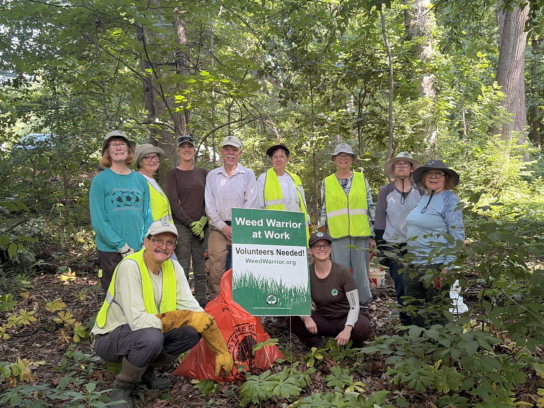
What’s green is not always good, no matter how beautiful it may seem. To determine which plants promote ecological growth requires a trained eye; an eye all certified Weed Warriors hold.
Montgomery County hosts a volunteer group called “Weed Warriors”. The group was started in response to a parks budget deficit. The lack of funding available for hiring companies to eliminate invasive plants from public parks was solved by retired ecologist Carole Bergmann in 1999.
Since then, the volunteer program has expanded and adopted new leadership, having certified around 475 Weed Warriors. Corinne Stephens currently coordinates the program.
How it Works
The program formally trains individuals to identify and get rid of invasive plants that disturb the natural environment. Certified Warriors dedicate their time and efforts to improving the ecological state of the parks by protecting native species.
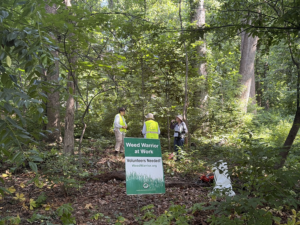
Certified volunteers working on site at Sligo Creek
“It’s a great way to get to know other people who live in your neighborhood, but you didn’t know you have a like-minded desire to save native species,” Stephens said. “They want to come out and volunteer every Friday morning, even in the cold. Sometimes they’re out here in the snow or at 90 degrees.”
The program teaches groups not to judge a plant by its cover, and to fully understand each species’ impact. Weed Warrior Edward Murtagh values the education he received through his volunteer work.
“I used to walk up Sligo Creek Park and just admire the beautiful yellow flowers that popped up in the springtime,” Murtagh said. “It was kind of a rude awakening taking the class.”
Learning how to tell if a native plant has been overtaken by an invasive one by looking at what grows on it is an important lesson. Non-native plants tend to host berries that are sugary with no nutrients. This ultimately stunts the growth and evolution of species that feed off of berries, like caterpillars and birds.
“They don’t have any better sense for themselves than human beings, they’d rather eat sugar,” Weed Warrior Barbara Francisco said.
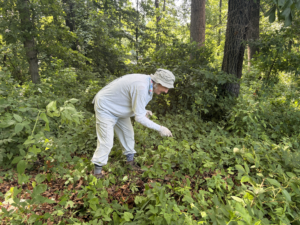
Francisco weeding a native plant
Diversity Fills the Ranks
One of Stephens’ goals since taking over the program has been to diversify its members through community outreach.
“I hired a staff member two years ago who speaks Spanish, and she’s been doing events totally in Spanish, which is a great group of people we’ve never really worked with before,” Stephens said. “We trained 15 new certified Weed Warriors, one of them was 18 and a couple were in their early 20s.”
Why it Matters
The program has even evolved past just cutting down plants.
“We also pull a lot of trash out of the park, the parks are a lot cleaner,” Murtagh said.
Volunteers emphasize the value of the program and its benefits toward the county.
“We have great parks in Montgomery County, but if the vines pull the trees down, then they’re not so great anymore,” Weed Warrior Webb Smedley said. “This is not an expensive program, and there’s a lot of value in utilizing volunteer labor to augment the professionals.”
The satisfaction Weed Warriors feel when successfully bettering a space motivates them to continue to volunteer.
“If you stick with the workdays and work closely with, collaborate with the parks you could see places just totally coming back to life rebounding,” Murtagh said.
To learn more about the Weed Warriors program and how to volunteer in Montgomery County visit their website.

Comments are closed.