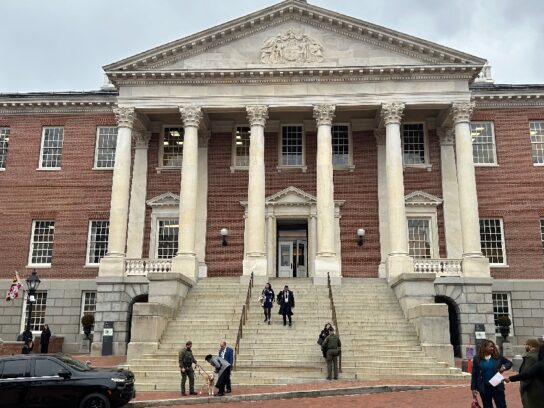
A slate of new laws go into effect beginning July 1 in Maryland, some directly affecting Montgomery County residents. Here’s a look at 10 you should know:
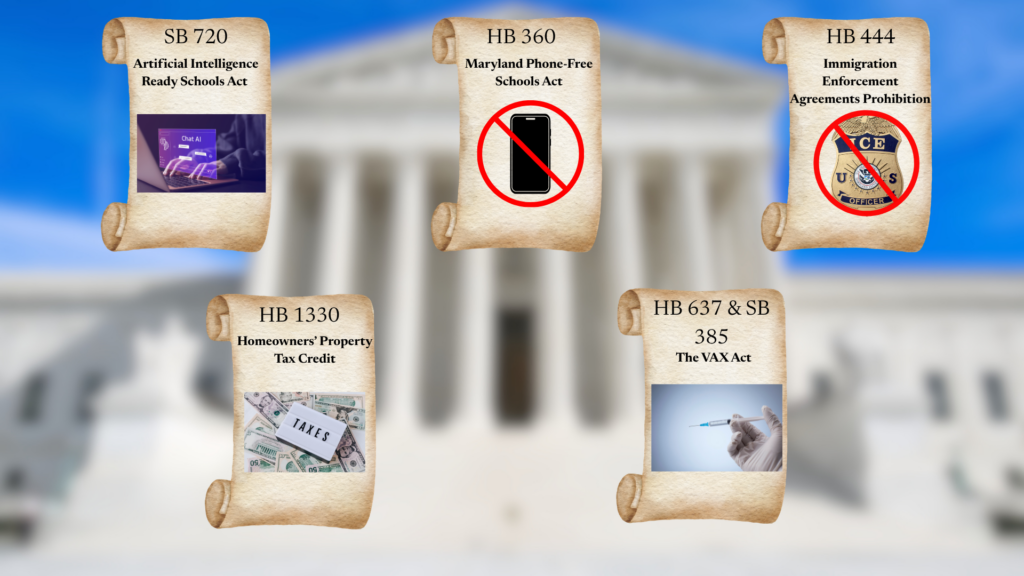
AI Ready Schools Act
(Senate Bill 720)
This law is designed to help Maryland schools use artificial intelligence in a safe and responsible way. It requires the state education department to create online guidance for teachers, students and parents on how to use AI ethically and effectively. Each school system must also appoint a coordinator to oversee AI use. In addition, a new statewide group called the Maryland AI Education Collaborative will study AI in schools and make recommendations for training, policies and best practices.
Maryland Phone-Free Schools Act
(House Bill 630)
This new law requires schools to limit student cell phone use during the school day starting in the 2026–27 academic year. Phones must be stored away during class time, but students can still use them during lunchtime or in emergencies. Exceptions are made for students with health needs, Individualized Education Programs or those students with disabilities who have 504 plans, or when teachers allow it for learning purposes. Schools must also create disciplinary rules for violations.
Immigration Enforcement Agreements Prohibition
(House Bill 444)
This legislation prohibits Maryland state and local governments, county sheriffs and their employees or agents from entering into agreements with the federal government that allow them to enforce civil immigration laws. It also requires any existing agreements like this to end immediately upon the law taking effect. The goal is to separate local law enforcement duties from federal immigration enforcement.
Homeowners’ Property Tax Credit (Year-Round Application)
(House Bill 1330)
This law is designed to reduce property taxes for eligible homeowners by allowing them to apply for property tax relief year-round, instead of only during a set period of the year. The credit helps eligible homeowners lower their property tax bills. Beginning July 1, 2027, residents will be able to apply at any time during the year for the credit.
The VAX Act (Immunizations and Preventive Services)
(House Bill 637 & Senate Bill 385)
These new laws change how Maryland handles vaccine and preventive care recommendations. They now require the Maryland Department of Health to base its recommendations on scientific evidence and go through a review process before adopting them, including public comment and analysis. The laws also update insurance coverage rules for vaccines, screenings and other preventive services, and adjust pharmacists’ ability to administer vaccines.
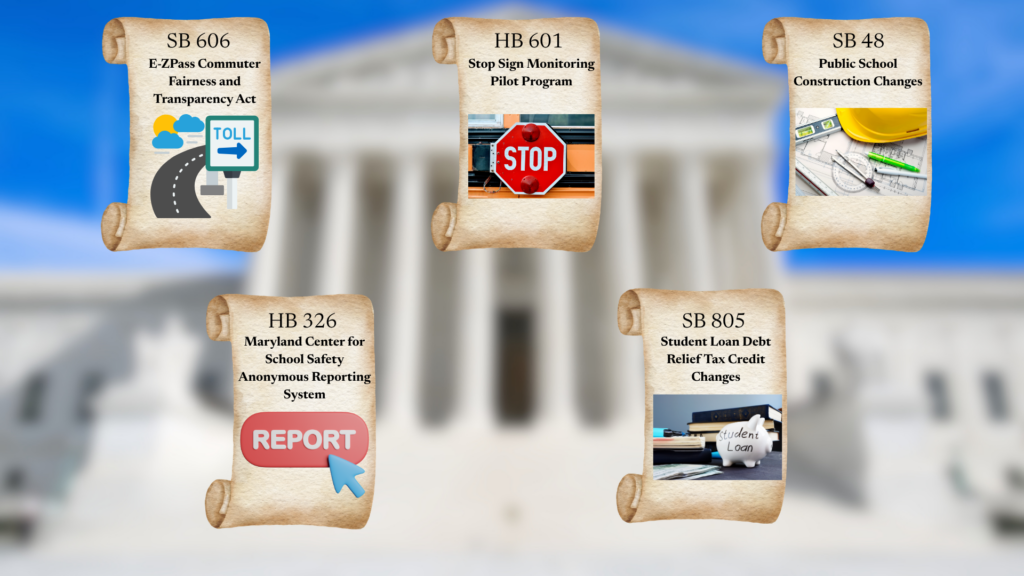
E-ZPass Commuter Fairness and Transparency Act
(Senate Bill 606)
The law requires the Maryland Transportation Authority to report on E-ZPass commuter discount plans and unused trips. The report must include data on how these programs are working and recommendations to reduce wasted or unused commuter trips. In some cases, the agency may also need to fix issues or reduce penalties that affect users.
Stop Sign Monitoring Pilot Program (Gaithersburg & Rockville)
(House Bill 601)
This legislation allows cameras to be used to monitor stop sign violations in school zones in Gaithersburg and Rockville. It expands a pilot program already used in other parts of Maryland. The goal is to improve road safety, especially near schools, by encouraging drivers to fully stop at stop signs.
Public School Construction Changes
(Senate Bill 48)
The law changes parts of how school construction projects are approved and managed in Maryland. It clarifies which projects need approval from the state superintendent of schools and updates certain approval deadlines. It also requires regular reviews of cost limits for school construction every four years to keep up with changing prices.
Maryland Center for School Safety Anonymous Reporting System
(House Bill 326)
This creates a statewide anonymous system for reporting school safety concerns. Students, staff and others can report threats or safety issues without giving their name. Each school system must participate, and the Maryland Center for School Safety will manage the system and train staff on how to use it. Reports will be kept confidential.
Student Loan Debt Relief Tax Credit Changes
(Senate Bill 805)
This changes rules for a tax credit that helps borrowers in the state of Maryland pay down their student loan debt. If someone does not use the full credit for student loan payments, they may now have to repay only the unused portion instead of the entire credit. It also gives the Maryland Higher Education Commission more flexibility to extend deadlines for proving how the credit was used.
Most of the new laws took effect July 1, although some provisions begin later or are phased in over the next year. For a full listing of new Maryland laws, visit the Maryland General Assembly Department of Legislative Services online publication.
Comments are closed.