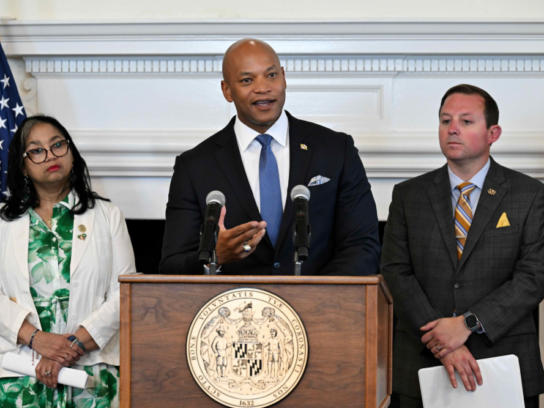
Gov. Wes Moore and Maryland legislative leaders announced Monday a bipartisan agreement to pass the Utility Relief Act, a measure aimed at lowering electricity costs and increasing oversight of utility companies as residents face rising energy bills.
Moore, joined by Senate President Bill Ferguson and House Speaker Joseline Peña-Melnyk, said the legislation represents a compromise intended to deliver both immediate and long-term relief for Maryland households and small businesses.
“[We are] working together to meet this moment for the people of our state,” Moore said, emphasizing collaboration between Democrats and Republicans. He added that leaders have spent months “working long hours to make life a little bit more affordable for the people of Maryland.”
Rising Electric Bills
The legislation comes as energy costs in the state have increased by about 13% over the past year, placing added strain on residents already dealing with inflation and economic uncertainty.
At the core of the Utility Relief Act is expanded authority for the Maryland Public Service Commission, which regulates utility rates.
The bill strengthens oversight by requiring more rigorous review of energy transmission projects, including those that previously bypassed full state evaluation. Lawmakers said an estimated $3.5 billion in supplemental energy projects over the past two decades were not adequately reviewed.
“This is the case where the state of Maryland will exercise its independent authority to ensure that projects are truly needed and done at a reasonable cost,” Senate President Bill Ferguson said during the press conference.
Pepco said the Utility Relief Act includes steps that could provide near-term bill relief and expand energy assistance for customers.
However, the company cautioned that some provisions could affect long-term grid reliability and potentially increase future costs if they limit infrastructure planning and investment.
The legislation also targets affordability for low- and moderate-income residents. It expands a program that caps monthly utility bills, potentially saving eligible households up to $1,400 annually, depending on their service area. Additionally, it streamlines access to state energy assistance programs to make them more efficient and easier to use.
A key consumer protection measure in the bill also focuses on rebates. Under the proposal, utility companies would be required to base rates on actual historical costs rather than projections. If those projections exceed real costs, the Public Service Commission would have the authority to require utilities to return the difference to customers.
Consumer advocates say navigating electricity billing issues can still be complex, particularly for renters. Matthew Kaufman, an investigator with the Montgomery County Office of Consumer Protection, said his office often fields complaints but lacks authority to regulate utilities directly.
“We don’t have the authority to regulate the utility companies, those regulations fall into the Public Service Commission.” he said.
Impact on the Community
For many residents, the rising costs are already having a direct impact. One Montgomery County resident, Adel Nahkla, a homeowner who is retired from the workforce, said his electric bill jumped from about $190 last year to roughly $460 for the same month this winter.
“We have to reduce other things that we use for the house in order to pay the bill,” Nahkla said. “It’s very unfair.” Nahkla added that the increase came without warning and has forced difficult financial decisions, including cutting back on everyday expenses for his family.
Peña-Melnyk described the bill as a response to what many Maryland residents have identified as their top financial concern. She shared a personal example, noting that her daughter, a medical student in Baltimore, kept her thermostat at 60 degrees during winter due to a monthly bill exceeding $300.
“Nothing has hit Marylanders harder in the pocketbook than the skyrocketing cost of home energy,” she said.
The bill also includes provisions to hold utility companies more accountable and closes loopholes that allowed additional charges. Lawmakers said large energy users, such as data centers, would be required to pay for necessary grid upgrades rather than passing those costs onto consumers.
A Product of Compromise
Ferguson called the legislation “a product of compromise” and highlighted the collaborative effort behind it. “We sit around a table and we figure it out and get it done,” he said.
Republican Sen. Steve Hershey has previously expressed concern that rising electricity costs require long-term structural solutions, noting earlier this month that lawmakers should focus on “real, lasting relief, not small, temporary savings.”
State leaders said the Utility Relief Act aims to do both, providing immediate savings while reforming the system to prevent future price spikes.
“This isn’t a temporary fix,” Peña-Melnyk said. “It is transformative and it will make a difference.”


Comments are closed.