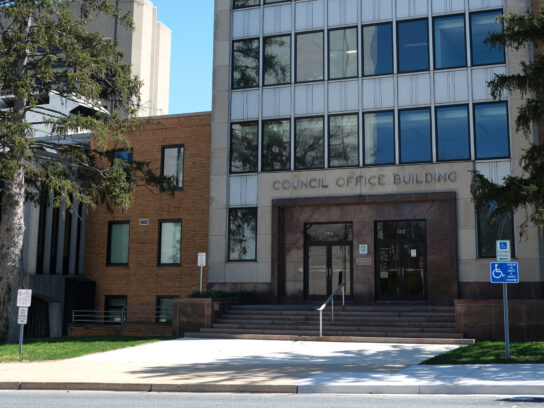
Members of two Montgomery County Council committees met Thursday to review and update the county’s Arts and Humanities Council‘s role and determine who are voting members.
The goal, according to Councilmember Will Jawando, is “to really modernize it.”
“The most important thing is that we support our arts community,” said Director of Recreation Gabe Albornoz. The arts council falls under his jurisdiction.
Recommendations from the Education and Culture and Government Operations and Fiscal Policy committee members next will go before the full council for adoption.
The arts council began in 1976 and has distributed $49 million of county funds to various projects and organizations between Fiscal Year 2018 and Fiscal Year 2025.
Some of the recommendations agreed upon during the committee hearing include establishing a Racial Equity and Social Justice impact statement, setting the number of representatives at between 11 and 15 and mandating a county wide needs assessment every two years.
Council members agreed that a racial equity and social justice impact statement is needed to ensure that grants are distributed fairly.
Council members are chosen by the County Executive and approved by the full council. The members must include two voting ex-officio members from the county government.
The county council committee members agreed to this although Suzan Jenkins, the arts council’s CEO, thought that county employees have a conflict of interest when voting on spending county funds. She thought the two county employees should have to recluse themselves on certain votes.
“We are concerned about” government overreach, Jenkins said, noting what happened to the former board members of the Kennedy Center who were replaced by President Donald Trump’s picks.
Luisa Cardona, Montgomery County’s Assistant Chief Administrative Officer, argued that the employees be permitted to vote. “They all have fiduciary responsibilities to our public dollars,” she said, noting that it was only two members out of at least 11 members so they wouldn’t have a majority vote. “This is not about control,” she said.
Councilmember Kate Stewart also agreed that the two members should have voting rights. Board members “wear different hats. You are put on a board by your expertise and the many hats you wear in the community,” she said.
Once someone is on a board, they should be full members and therefore, be on the record for residents to see, said Councilmember Sidney Katz.
Having someone from the county on the board “makes sense,” added Councilmember Kristin Mink. She offered a compromise that only one of the two county employees would have a vote, but that was not recommended by the committee members.
Jenkins suggested the county employee board members could recuse themselves when they had a conflict of interest, adding “It’s a conflict. It’s a noted conflict.”
Stewart suggested that a member of the county’s ethics commission conduct a training for the full arts council to “discuss these scenarios before they actually come to the board.”
The council committee members also agreed to recommend payment of a supplemental appropriation of $53,788 from undesignated general funds to cover an outstanding balance for the cost of the cultural plan.
A county audit discovered that money had been allocated incorrectly. That money has since been returned to the county, which left a unpaid balance to the contract for the cultural plan.
Albornoz explained that there is one staff member and one aide responsible for reviewing 588 Recreation Department funding requests and that in part led to the mistake. “I think we have made great improvements” to ensure it doesn’t happen again, he said.
Jenkins also urged the councilmembers to discuss what is public art and what the arts council can fund.