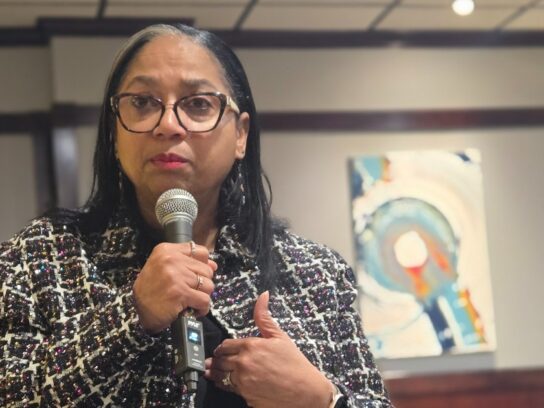
Maryland House Speaker Josaline Peña-Melnyk told members of the District 18 breakfast club Monday that she is motivated to help because of her childhood in poverty in the Dominican Republic.
Her Personal Story
Speaking before about 60 people gathered at the Parkway Deli in Silver Spring, Peña-Melnyk said she spent her first eight years living with her grandparents in a house with a cement floor and a metal roof filled with holes. Her job was to grab buckets and place them beneath the holes every time it rained.
“We did not have indoor plumbing. We had a latrine. I walked one hour to school,” she recalled. I know what it’s like to be hungry, because sometimes we did not have a meal.”
These childhood memories are what form her politics, she said, adding, ‘My motive is never go back.”
After serving as a prosecutor, district attorney, College Park city councilmember and 20 years in the state legislature, “I never thought someone like me” would end up as Speaker of the House of Delegates, she declared.
2026 Legislative Review
She proudly shared legislative accomplishments during the 2026 session, from increasing SNAP benefits to initiatives in health, housing, transportation and the environment to an appreciative Democratic audience.
Much of it was necessary due to federal layoffs and program cuts, said Peña-Melnyk, the first Afro-Latina to serve as House Speaker.
“Our budget reflects our values,” she declared, adding, “We have to fight and push against the [President Donald] Trump Administration.”
“We are going backwards. We are losing our civil rights. We are. We are racial profiling. Whether you are Black or Brown, they are trying to erase our history. When there is no respect for the Constitution, there is no respect for all three branches of government, how can we not do anything? It just did not make any sense to me.”
Under newly passed bills Gov. Wes Moore should sign into law soon, ICE cannot deputize local law enforcement nor can they wear masks, she noted.
She talked about successful state efforts to help residents pay their utility bills and keep those costs down. She also explained that juveniles younger than 15 years old will no longer be charged as adults. Nor will underage juveniles be imprisoned with adults unless their crimes are very serious, including murder.
When questioned about the divisiveness in today’s politics, Peña-Melnyk said she “worked hard” to remain civil. “I am not going to take it, and I am not going to allow it.” Respect for others is important, she added.


Comments are closed.