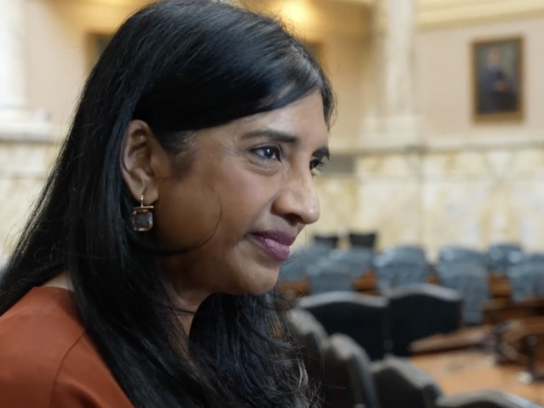
As Maryland’s first Asian-American lieutenant governor, Aruna Miller often finds herself in rooms where few people share her background.
But that’s nothing new.
“I’ve spent my entire life walking into places that didn’t look like me and where I didn’t feel like I belonged,” Miller said in an exclusive interview with MCM News.
Now the 10th lieutenant governor of Maryland, Miller’s journey, from a city in India called Hyderabad (about the size of Chicago) where she was born to moving to the United States as a young girl, and a career as a engineer, Miller has made her mark most prominently as an elected official. She currently serves as the top-ranking woman in Maryland politics and second in command to Gov. Wes Moore. As the United Nations marks International Women’s Day 2026 with the theme, “Rights. Justice. Action.,” Miller says her role is not just about holding office, but expanding opportunity for others.
A Montgomery County path to leadership
Miller immigrated to the U.S. without speaking English. She eventually built a life and career in Montgomery County, where she has lived for 36 years and counting.
Before entering politics, Miller worked as a Montgomery County Department of Transportation engineer and then elected official in Maryland’s House of Delegates representing District 15, places where she says where she often stood out.
“Whether it was being an immigrant who didn’t speak a word of English, a female engineer in a male-dominated field, or an Indian-American legislator in a legislature that looked nothing like me,” Miller said, “those experiences shaped who I am.”
Instead of discouraging her, she said those moments reinforced her sense of purpose.
“It’s not a sign telling you not to be there,” she said. “It’s a force telling you that you have to be there — to make spaces bigger for others.”
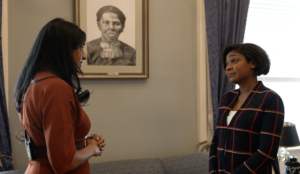
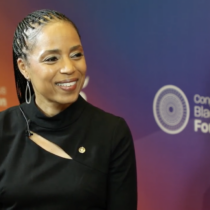
Lt. Gov. Aruna Miller speaks to MCM News.
Redefining the role of Lieutenant Governor
In reading Maryland’s State Constitution, one quickly learns that the role of lieutenant governor comes with no detailed job description beyond stepping into power if the governor cannot perform his duties.
But Miller says she and Gov. Moore have worked to expand the role’s impact.
“While it’s an honor to be the first Asian-American immigrant lieutenant governor,” she said, “That’s not the assignment. The assignment is to open doors and pathways for others.”
Miller points to the administration’s cabinet as one example.
“Our cabinet is the most diverse in Maryland’s history,” she said. “Fifty percent are women.”
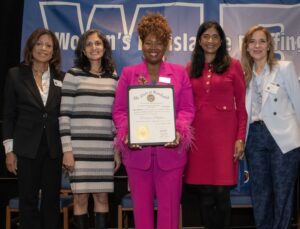
Montgomery County’s 2026 Women’s Legislative Briefing
Speaking out on immigration and identity
Representing one of the nation’s most diverse states also means confronting national political rhetoric about immigration.
Miller said messages suggesting the U.S. should prioritize some Americans over immigrants are deeply troubling. Sitting down for this interview just one day after the State of the Union, Miller remarked on President Trump’s statement in his address that, “The first duty of the American government is to protect American citizens, not illegal aliens.”
“That’s very hurtful, and honestly, that’s not what America is,” Miller said. “America is the place where people from all over the world choose to come and make it their homeland.”
She noted that even conservative icons have embraced that idea in the past.
“Ronald Reagan said that anybody could come here and be an American,” Miller said.
Balancing motherhood and leadership
Miller has also spoken openly about how motherhood shaped her political career.
During an appearance at the county’s Women’s Legislative Briefing earlier this year, she discussed the challenges women face balancing family and professional life.
“Being a mother isn’t an illness and it’s definitely not a vacation,” Miller said to a standing room only crowd who had come out in below freezing temperatures to hear her and the other panelists speak. Miller is a staunch advocate for workplace policies that support parents and caregivers, rather than penalize them.
She said flexible policies and understanding employers are essential for women who want to remain active in public service or professional life.
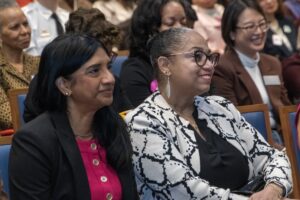
Lt. Gov. Aruna Miller and Speaker Joseline A. Peña-Melnyk at the 2026 Women’s Legislative Briefing.
Mentorship from other women leaders
Miller credits other women with helping guide her career, especially during her first year as a state delegate representing Montgomery County.
One of those mentors was Joseline Peña‑Melnyk, now speaker of the Maryland House of Delegates.
“We have to work twice as hard,” Peña-Melnyk said of women in politics.
Born in the Dominican Republic and raised in the Bronx, Peña-Melnyk has also broken barriers in Maryland politics, building a career as an assistant U.S. attorney before rising to lead the House.
The two leaders say they often share moments of camaraderie in a house chamber with walls adorned by past male leaders. Laughing and embracing in private offices and at public events, they are a visible reminder of the support networks that women disrupters to the status quo so desperately need in the work of movement making.
Making her mark on Maryland politics
Miller says mentorship, advocacy and public service remain central to her work.
Her office has prioritized conversations around mental health, an issue close to her personally, as her father struggled with bipolar disorder.
But as Maryland continues to lead the nation as one of the most diverse states in the Union, Miller believes the most important part of leadership is ensuring the next generation sees themselves represented in positions of power.
For Miller, breaking barriers was never the end goal.
Opening doors for others, she said, is the real assignment.

Comments are closed.