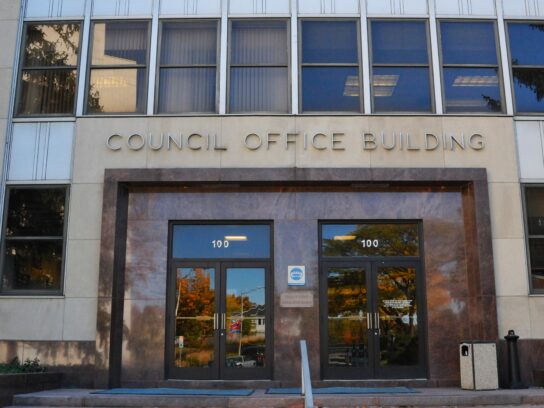
The Montgomery County Council did not pass any sweeping new law Tuesday. Instead, the Council spent its housekeeping session tightening rules already on the books. Members closed a licensing loophole tied to human trafficking, updated gun restrictions to survive a court challenge, and expanded a tax credit meant to open the door to homeownership.
One councilmember summed up the day calling it “housekeeping.”
Closing a loophole tied to trafficking
The Council formally introduced Bill 34-26 on Tuesday. The legislation targets bodywork and massage businesses that officials say sometimes operate as fronts for human trafficking. The Council scheduled a public hearing for Sept. 15.
Councilmember Dawn Luedtke, the bill’s lead sponsor, said the legislation grew out of ongoing conversations about how trafficking hides in plain sight.
“Trafficking doesn’t always look the way people expect it to,” Luedtke said. “It often occurs in businesses that appear perfectly legitimate until you look deeper. That’s why it’s important to have strong coordination.”
Luedtke said the bill closes gaps between county agencies.
“This is aimed to close gaps and give us tools that different stakeholder groups within county government can work together, and close that gap in the best interest of our public and those who are victimized by trafficking,” Luedtke said.
MCM reported this week that Bill 34-26 would tighten licensing rules for bodywork establishments. The bill would bar the county from issuing a license to anyone previously convicted of trafficking or prostitution-related offenses, or whose past business license was revoked.
How the housekeeping session played out on guns
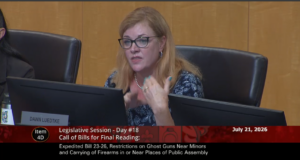
Councilmembers gave final approval, 10-1, to Expedited Bill 23-26. The bill updates the county’s ghost gun and public-assembly firearm restrictions.
The bill does not create new restrictions. Instead, it brings county law in line with an April 28 Maryland Supreme Court ruling. That ruling found parts of the county’s existing gun laws conflicted with state authority.
Luedtke described the bill as pure cleanup. “This doesn’t add new law in any way, shape or form,” she said, characterizing it as removing county rules that exceed the county’s legal authority so that what remains can actually be enforced.
Councilmember Laurie-Anne Sayles, an at-large member, pushed back with a pointed question. She asked how a law enforcement officer would know someone was carrying a concealed weapon without a metal detector present. She also asked whether the law could create unintended consequences for communities she said are already overpoliced and over-surveilled.
In response, Luedtke said the bill does not change who is legally allowed to carry a firearm under state law.
“This bill includes schools and public assembly. The only people who can have guns on school grounds are law enforcement officers,” Luedtke said. “It must be concealed, and you must state you have one.”
Luedtke added that the county’s authority has limits. “We don’t have authority to do anything that conflicts with that state law,” she said. “We need to ensure we are making safe spaces for all of our communities.”
Expanding a path to homeownership
The Council also passed Bill 15-26 during the housekeeping session. The legislation expands a property tax credit for Habitat for Humanity rehabilitation projects.
Councilmember Andrew Friedson said the credit supports one of the county’s few remaining paths to affordable homeownership.
“[Habitat for Humanity] provides homeownership opportunities to families between 30 and 80% of area median income,” Friedson said. “It’s even challenging to find rental income, so this allows affordable homeownership opportunities, which is critical.”
Supporters said the county’s affordability crisis extends beyond renting. Meanwhile, backers of the bill argued that homeownership, not just rental assistance, builds long-term financial stability.
“We lack the ability to build generational wealth,” one supporter said of the barriers facing lower-income families seeking to buy a home.