Potomac Riverkeepers Network called the Potomac Pipeline sewage release “one of the worst, if not the worst, sewage spills in U.S. history. Not only has this event created an on-going regional public health and environmental emergency, but it’s threatened our community’s dependence on the river – for recreation, for subsistence and for livelihoods.”
More than five weeks after a section of the Potomac Interceptor Pipeline collapsed and spewed millions of gallons of untreated sewage into the Potomac River, a temporary bypass of the damaged pipe is completed, and repair efforts and restoration of the water flow is underway.
A section of the pipeline that transports wastewater from Montgomery County into Washington, D.C. collapsed near the Clara Barton Parkway and I 495 by Cabin John on Jan. 19.
DC Water will hold a public meeting Thursday at 7 p.m. at Walt Whitman High School, located at 7100 Whittier Blvd. in Bethesda, to update the public concerning the pipe break and resulting sewage spill. The meeting will be streamed live.
Information Session
The Metropolitan Area Council of Governments (COG) held an information session Monday to update the region on what has happened since the spill occurred. During the 90-minute session, numerous officials stressed that the water supply in the area is safe to drink. However, the bacteria levels are too high for people and pets to immerse themselves in the river, drink water from the river or fish in the Potomac River, they stressed.
The interceptor pipeline is a 54-mile sewer line owned and operated by DC Water that sends wastewater from parts of Montgomery County to treatment facilities in the District.
“This was not a routine break by a long shot,” said David Gadis, CEO and general manager at DC Water. The collapsed pipe was 72 inches, he said.
When the reinforced concrete pipeline was constructed in the 196os, rocks were blasted and backfill was used where the rocks had been. Part of the reason the for the collapse is some of that backfill ended up in the pipe.
Bacteria Impact
According to Cherie Schultz of the Interstate Commission on the Potomac River Basin, bacteria die off “pretty rapidly,” even during the very cold recent temperatures.
However, she said, it is possible that nutrients from the sewage that spilled into the Potomac River may increase algae growth and result in harmful algae blooms. She also said that depositing of sewage sludge may increase biological oxygen demands, resulting in higher fish kills than normal.
Stabilizing the Situation
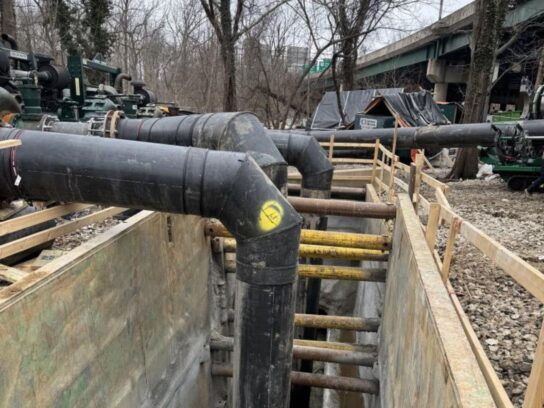
After the collapse, DC Water constructed a bypass pumping system in about five days to contain much of the overflow by capturing and rerouting wastewater around the collapsed segment. This temporarily diverts all wastewater away from the damaged section.
Currently, the utility has installed trench boxes to stabilize the area. Crews are working on a section of the pipe that may have large rocks and debris.
There has been no overflow into the Potomac since Feb. 9. Up until then, 243 million gallons of untreated sewage flowed into the river. Generally, the pipeline conveys 60 million gallons daily.
Multiple organizations are monitoring the bacteria levels at various spots along the Potomac River. One of the monitoring sites is by Old Anglers Inn in Potomac.
Pipeline Rebuild & Recovery
DC Water’s goal is to rebuild the pipeline at that area “but also make it more resilient,” Gadis said. Once that is completed, the utility will environmentally restore the affected areas, he said.
Matt Brown, DC Water’s chief operating officer, estimated that the utility will spend $350 million during the next five years and a total of $600 million over 10 years to complete the restoration.
Sean O’Donnell of the county’s public health department said his office has had “ongoing conversations” with officials to stay updated on the issue. Because DC Water takes its water from upstream of the spill, drinking water is not affected.


Comments are closed.