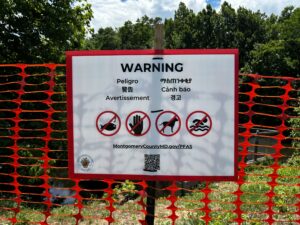
Sign posted near Great Seneca and Sam Eig highways in Gaithersburg
High levels of “forever chemicals” — which can increase risk of cancer — were found in a stream and pond along Great Seneca Highway. It may be tied to firefighting foam used at the county’s former public safety training facility.
During an announcement Monday, officials stressed that drinking water is safe but people and pets should not enter the affected area, which is the stream and stormwater pond along Great Seneca between Midsummer Circle and Blackwell Drive, according to the map provided by the county.
Signs will be posted around the contaminated areas.
What Are “Forever Chemicals?”
Perfluoroalkyl and polyfluoroalkyl substances (PFAS) or “forever chemicals” are human-made synthetic chemicals that do not break down in the environment. Instead they accumulate over time, county officials explained. They are in everyday products to resist water, heat, grease — like nonstick cookware, waterproof clothing and firefighting foam. For decades they have been used but the health risks were not widely known until more recently.
In 2024, the U.S. Environmental Protection Agency made the first national drinking water standards for PFAS.
Intentionally Added to the Firefighting Foam
WSSC Water found traces of PFAS in the Muddy Branch water shed, according to County Environmental Protection Director Jennifer Macedonia. WSSC asked the state for further sampling of Muddy Branch, and the state found high levels of PFAS in an area on and adjacent to site of the county’s former public safety training facility.
“There are reasons to suspect a source may be the PFAS that manufacturers intentionally added to the firefighting foam,” Macedonia said. There will be more investigation.
The foam was used on the former training site from the 1970s through 2015. That kind of foam is no longer used by the county and is now banned in Maryland. The highest level was detected in a stormwater pond near the training academy site. Elevated levels were also found in a stream that flows to the pond.
County Executive Marc Elrich said the county is taking legal action against companies that make PFAS. In 2023, the county filed a lawsuit against 24 manufacturers, he said.
This contamination news comes as the area continues to remedy the Potomac River sewage spill from January.
The Risks
County Health Officer Dr. Kisha Davis said the risks of PFAS include increased risk of some cancers, cholesterol changes and impacts on immunity related to vaccines especially for kids.
Davis said the primary risk is through ingestion. The risk comes from drinking it over a long period of time or eating fish from contaminated water. It is not easily absorbed through skin but it is recommended to avoid contact until it is determined if there are other pollutants and also to avoid accidental ingestion.
“The risk from PFAS is not caused from a single glass of water, a weekend swim or an accidental splash. The health risks are tied to chronic exposure” as in everyday for years, according to Davis.
WSSC Water PFAS Program Manager Laura O’Donnell stressed that “this is not a public water supply issue.” The alert is about water in the stormwater pond and stream, not the water produced at the Potomac and Patuxent water filtration plants, O’Donnell said.
Guidance
Officials advise the following:
- Do not enter the affected streams or stormwater ponds
- Do not let pets enter
- Do not fish (or eat fish) from these waters (cleaning/cooking it does not remove risk)
- Wash skin and hands thoroughly if there is accidental contact
What’s Next
There will be a community meeting about this issue Wednesday, June 17 at DuFief Elementary School at 7 p.m.
There will be more testing of water and soil in the impacted area to better understand the extent of the contamination.
The county also has a webpage for updates about the contamination.
Watch Dr. Davis discuss the risks and guidance below:
View this post on Instagram


Comments are closed.