
Montgomery County homeowners are opening their mailboxes this month to higher property tax bills. Levy Year 2026, which began July 1 reflect a decision the County Council made in May: eliminating the Income Tax Offset Credit (ITOC), a $692 break that had appeared on most homeowners’ bills for years. Two months after that vote, the impact is no longer theoretical.
The county did not raise the property tax rate this year. But for many homeowners, the loss of the credit, combined with rising assessments, means a bill that is higher than last year’s regardless.
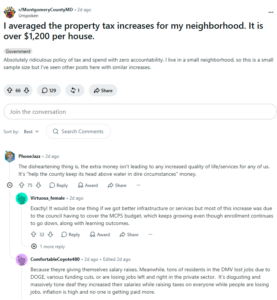
Residents react to higher tax bills in county Reddit posts.
Reaction has been immediate. In neighborhood Facebook groups, on Nextdoor, and across Reddit threads dedicated to the county, residents have been comparing notes, posting their bills, and asking why the increase feels so much larger than officials suggested it would be. The volume of that reaction, dozens of posts and hundreds of comments across threads, is itself a sign of how widely the change is landing.
What it looks like on a bill
For Sylvia Saunders, the number wasn’t abstract. Saunders founded East County Village Seniors. She’s been retired for nearly 30 years and looked at her bill expecting the usual number. She didn’t find it.
“I looked at my bill and thought, ‘wow, I don’t even make this much money,'” Saunders said.
Her 2025 bill had included a $692 County Property Tax Credit, a $1,320.09 county homeowners credit, a $2.44 state homestead credit, and a $2,180 state assessment. This year, she said, “there is not one credit on here, not one.”
Saunders hadn’t realized the $692 line had even been on her bill until it vanished. “ITOC is confusing,” she said. “$692 is a lot of money.”
The timing made it worse. Saunders just paid for a new roof on an 18-month plan. Homeowners only get two months to pay their property tax bill in full or start an installment plan.
“I think this is disgusting. This is not a time to be taxing seniors, or people who can’t find a job,” Saunders said. “It’s inconsiderate. It’s disrespectful. I’m not just saying it for seniors. I’m saying it for everybody. They don’t know who’s working, who’s not working, or who’s making less money.”
A credit with an expiration date
Emily Van Loon has spent years watching this up close. She’s the vice president and treasurer of the Village of Takoma Park, a nonprofit that helps seniors age in place. It’s part of a national network of similar “villages” in Silver Spring, Chevy Chase and elsewhere.
The village focuses on lower-income seniors, Van Loon said. That includes renters, who aren’t directly hit by property taxes, and longtime homeowners who bought in Takoma Park decades before it became expensive.
“They live in very small ranchers,” Van Loon said. Many are widows managing a home alone for the first time. “They’re kind of backed into a corner where they need to maintain their homes, pay rising utility bills… and then the weight of real estate taxes.”
Montgomery County does offer help. Homeowners 65 and older who’ve lived in their home for 40 years can get a 20% property tax credit. But Van Loon said the credit only lasts seven years.
“What do they expect you to do in seven years?” Van Loon said. “It’s great if you are alive, but my God, the county says too bad, so sad, we’re gonna make you pay more ’cause you happen to live a little bit longer.”
When the credit does run out, the loss can be severe. Van Loon said a village member in her mid-70s lost both the senior credit and the Homestead exemption this year. Her real estate taxes went up $1,800, with no increase in her home’s assessment at all.
Van Loon has her own stake in the math. She’s 73. Her husband is 75. They’ve lived in their Takoma Park home 38 years, two shy of the 40-year mark.
“I have two more years to wait,” she said. “To get to the 40-year credit, to get a credit that’s only good for seven years.”
Why officials disagree
County Executive Marc Elrich opposed eliminating the credit from the start. He said the change would raise taxes on more than 201,000 households by a flat $692 each. Asked for comment, Council President Natali Fani-González defended the decision in a statement to MCM. Elrich had proposed a 6% property tax increase and an income tax hike on all wage earners, she said, and the Council rejected both. Instead, the Council passed a progressive income tax structure that cuts taxes for 95% of wage earners. To pay for that cut, the county eliminated the ITOC.
“To pay for this tax cut for the vast majority of wage earners, we eliminated the poorly targeted and costly Income Tax Offset Credit,” Fani-González said. The county redirected the savings to Montgomery County Public Schools and other services, she said.
Both officials are standing by those positions now that bills have gone out. At a recent media briefing, Elrich said, “This is a tax increase no matter what the county said.” He added that many homeowners were surprised to see the $692 credit gone entirely.
Confusion or complexity
Saunders’ experience points to something bigger than one dollar amount. The county runs several overlapping tax credit programs. Each has its own rules. Each has its own deadline.
The Homestead credit is a one-time filing. Homeowners must have it on file with the state by May 1 for the ITOC to apply if the Council ever restores it. The Homeowners’ Property Tax Credit works differently. It requires a new application every year, due Oct. 1. A separate credit for residents 65 and older who’ve lived in their home at least 40 years has an April 1 deadline. If you miss one deadline you can miss the relief entirely.
What homeowners can do now
Homeowners hoping the credit returns still need a Homestead Property Tax Credit application on file with the state. MCM broke down the deadlines and relief programs available now in a service piece published earlier this month.



Comments are closed.