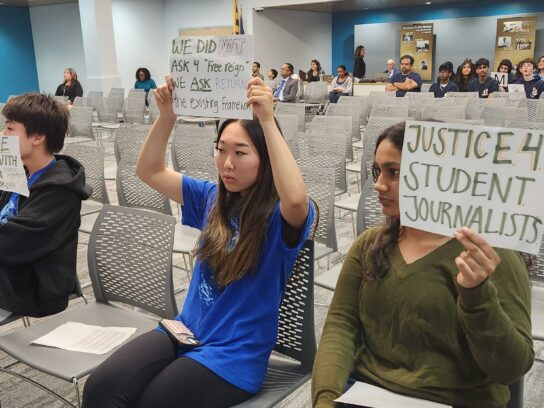
Student journalists challenging a Montgomery County Public Schools (MCPS) memo on administrative review of school publications say they left the June 25 Board of Education meeting frustrated, arguing that district leaders still have not addressed their main concerns about press freedom and student editorial independence.
Following public testimony before the board, Richard Montgomery High School student journalist Ian Chen said Superintendent Thomas Taylor’s response largely repeated previous statements, “the response from Dr. Taylor, once again, did not address our concerns that the text of the memo strays far beyond what the law permits.”
Chen said after the meeting, “What we find confusing is that he essentially agreed with us that libel, slander and illegal content have no place in our papers. If he remains committed to following the New Voices Act, then why is he allowing this memo to remain in place?”
Chen argued that language in the memo could be interpreted broadly enough to justify censorship of legitimate reporting.
“This memo includes language so vague that it gives administrators basically a blank check to kill any story that is controversial,” he said.
Other student journalists expressed similar concerns
Abigail Lee, incoming editor-in-chief of The Tide at Richard Montgomery High School, said she was surprised that district leaders largely reiterated previous statements. “The response was almost a repetition of what we’ve been hearing for the past weeks,” Lee said.
“There needs to be more clarification and there needs to be a response that is going to address the things that we mentioned in the open letter,” she added.
Aditi Lyer, an incoming co-editor-in-chief of The Tide, described the board’s response as “anticlimactic.”
“It really just didn’t clarify anything that we didn’t already know,” Lyer said. “Regarding his response that the intent of the memo wasn’t to prevent student journalists from reporting on important issues, that might not be the intent, but that’s what’s going to happen.”
Lyer said students worry that the policy could create a chilling effect even if stories are not explicitly blocked. “Students might feel afraid or not as confident to truly write what they have to write and what is meaningful,” she said.
The comments came after months of debate surrounding a March memorandum issued by Dr. Peter Moran, Chief of Division School Leadership and Improvement, directing high schools to designate administrators to review student news stories before publication.
Student journalists argue the policy risks undermining protections guaranteed under Maryland’s student press law framework, while district officials maintain it is consistent with existing rules and intended to ensure responsible publication practices.
Advocates warn unclear policies weaken protections
Andrea Negri, Scholastic Press Rights Director for the Journalism Education Association, said she became involved after students searched for support while organizing their response to the memo.
She said student journalism is often the first place where broader administrative tensions become visible.
“Sometimes there was some response to an article that was published or a photo that was published, and there’s an urge to tighten up the reins,” she said.
But she cautioned that vague language in administrative directives can create legal and ethical problems.
“Sometimes the truth can be embarrassing,” Andrea said, adding that student press laws typically only allow censorship in narrow categories such as unlawful or substantially disruptive content.
She also emphasized the educational purpose of student journalism.
“It is something that is produced by the students that the whole student body and sometimes the community can see,” she said. “It teaches communication, problem solving, and how to find reliable sources.”
District defends policy and appeals process
MCPS officials have defended the memo, stating it aligns with board policy and Maryland law and is intended as prior review, not prior restraint.
Superintendent Taylor said during the June Board Meeting that the system includes safeguards for student journalists.
“We are very proud of our student journalists,” Taylor said. “We do also have a responsibility as adults, and that responsibility we are going to follow in compliance with the Maryland New Voices Act.”
The district also pointed to its appeals process, arguing students have a formal pathway if disputes arise.
“You do, as students, have a right to appeal decisions that are made, and we have an appeals office that handles those things centrally,” Taylor added.
Ongoing process
Students are also calling on members of the Montgomery County community to support their efforts by contacting the Board of Education.
“The more support we get from the community, the better we can show the board that this is not just an effort by students,” Ian Chen said. “It is press freedom experts, legal experts, parents, neighbors, and anybody who cares about journalism who is on our side.”
Students say community support will play an important role as they continue urging school officials to revise or withdraw the policy.
For now, the dispute underscores a central tension in scholastic journalism: how to balance educational oversight with the independence students say is essential to learning how to report freely, responsibly, and in the public interest.

Comments are closed.