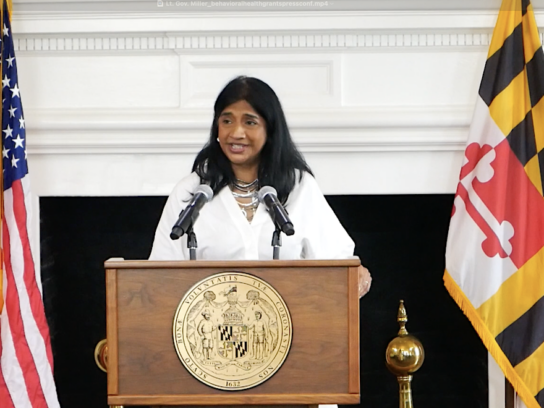
Maryland will invest another $96 million in school-based mental health services next school year, expanding counseling, crisis intervention and substance abuse prevention programs expected to reach more than 200,000 students across the state.
State leaders announced the funding Friday afternoon at the Maryland State House, backed by one of Poolesville’s most powerful residents — Lt. Gov. Aruna Miller, who said student mental health must become interwoven into academic programs and be seen as fundamental as reading and math is to a child’s education.
“Here’s what I’ve come to believe: a child cannot focus on algebra if they are overwhelmed by anxiety,” said Miller. “They can’t read and concentrate on that if they are carrying trauma, and they certainly can’t reach their full potential if they are suffering in silence.”
The lieutenant governor then offered a deeply personal account of what her childhood was like experiencing a parent suffering from a mental health condition.
“I grew up loving someone who had mental illness. My father had bipolar disorder,” she began. “His energy filled every room that he walked into. In fact, it was overwhelming at times. It was like standing too close to the sun. Then there were days that he would suddenly shutdown. He would sleep for weeks without getting out of bed, and not evening going to work.”
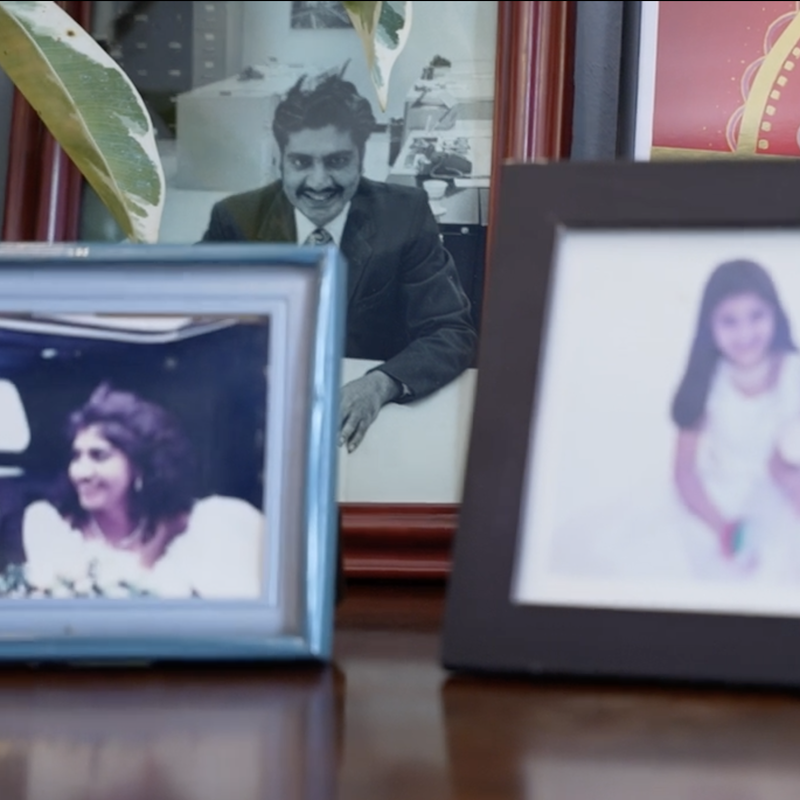
A photo of Lt. Gov. Miller’s father sits on a desk in her office at the Maryland State House among other family photos. (Photo Credit: Andrew Nguyen)
Miller said her family didn’t have a name for his condition and chalked it up to her father simply battling with “life” and all that comes along with it. She said her father’s generation did not talk about such things or seek out psychological guidance as openly as generations of today.
“They were taught to hide it. But it doesn’t have to be that way,” Miller said.
“All of us here today have an opportunity to raise a generation of young people who know that asking for help isn’t a weakness. It’s a strength and healing.”
The investment will fund counseling, crisis intervention, family support services and what the lieutenant governor salled, “substance use prevention” starting in the 2026-27 academic school year. Additional behavioral health programs for students in prekindergarten through 12th grade during the next school year will also be funded through the grant.
The money is being distributed through Maryland’s Consortium on Coordinated Community Supports, a statewide initiative created under the Blueprint for Maryland’s Future education reform law, which was passed in 2021 by the Maryland General Assembly to bolster the statewide academic programs into a “world-class education system,” according to state documents. Maryland officials said more than 160,000 students are receiving services this school year in 84% of Maryland schools, with more than 85% showing improvement or maintaining positive behavioral health outcomes. More than 90% of students and families reported satisfaction with the services.
House Speaker Joseline Peña-Melnyk said the need for attention to mental wellness for youth is needed now, more than ever.
“About 105,000 Maryland adolescents experience a major depressive episode each year,” Peña-Melnyk said. “Approximately 63,000 have serious thoughts of suicide.”
She pointed to research supported by the National Alliance on Mental Illness suggesting that half of all lifetime mental illnesses begin by age 14.
“With everything that’s happening in this world, we have to make mental health a priority,” Peña-Melnyk said.
State Sen. Katie Fry Hester, who sponsored the legislation creating the Consortium before the COVID-19 pandemic, said lawmakers recognized early that schools could not meet students’ behavioral health needs in a vaccum.
“When we talk about the future of Maryland, we often talk about academic achievement and workforce readiness, and even getting our young people skilled up on artificial intelligence because you’re going to need it in the workplace,” Hester said. “But as the lieutenant governor said, you can’t concentrate on algebra if you are dealing with other things.”
Since the program launched, Hester said it has already helped around 175,000 students statewide. She then shared the story of a 5-year-old girl who was living in a hotel after fleeing domestic violence with her mother. The child had become nonverbal and suffered severe separation anxiety.
“And after just five weeks of support from a provider that was provided through the Consortium, she had built up enough trust with her therapist go to school with out her mother, to begin to participate and she is now thriving,” said Hester. “So, that’s just one of the 175,000 students that we have helped thus far.”
David Rudolph, chairman of the Maryland Consortium on Coordinated Community Supports and a former public school teacher and state delegate, said Maryland’s approach is unlike any other in the nation.
“We are doing something that nobody has done across the country,” Rudolph said. “It is not a cheap endeavor, but it’s a worthy endeavor.”
The announcement comes as Montgomery County Public Schools continue balancing growing student mental health needs with significant budget shortfalls. Although the Montgomery County Council approved a fully-funded operating budget for MCPS for fiscal 2027, the school system did not receive the full amount requested and has announced the elimination of more than 400 positions to help close its budget gap. State officials said the new behavioral health funding is intended to ensure schools can continue expanding access to counseling and other services despite those financial challenges.
For Miller, the issue remains deeply personal.
“The support we are funding today is the support I wish my family had,” she said, adding that Maryland’s approach recognizes that teachers cannot shoulder the responsibility alone.
“Teachers educate. Families nurture. Clinicians heal,” Miller said. “When we connect those pieces together, we give every child the opportunity not just to succeed in school, but to thrive in life.”
More Funding Announced
On Monday the Moore-Miller administration announced a $6.3 million grant to community-based organizations for fiscal year 2027,. It will aid rapid-response to substance abuse cases and serve unmet and urgent overdose-related needs around the state.


Comments are closed.